.png)
Building Blocks for Reading and Writing: How Early Literacy Grows Through Play at Te Ōki
Earlier in the year, we were lucky to welcome Dene Franklin to our Te Ōki parent evening. He shared what primary teachers hope tamariki can do when they begin school — not just naming letters or counting objects, but arriving with curiosity, confidence, and a love of learning.
His kōrero was a great reminder that the foundations for literacy (and numeracy) start long before children pick up a pencil. They begin here — in our sandpits, story times, games, and daily routines, through rich play and conversation with people who know them best.
Early Literacy in a Play-Based Curriculum
At Te Ōki, literacy is alive in everything we do. It’s found in the way children tell stories during play, recognise their name on a drink bottle, or join in a waiata. It grows from meaningful experiences — reading familiar pūrākau from our local area, noticing words and symbols in the environment, and having teachers who take the time to listen, respond, and extend language with specific strategies.
Our curriculum is grounded in Te Whāriki’s Communication | Mana Reo strand, and woven with the stories of this place — our local Māori histories, myths and legends. Through these stories, children learn that language holds identity and connection; it links us to people, whenua, and culture.


Infants – Literacy Begins with Relationship
In Kākano, our youngest tamariki begin their literacy journey through loving relationships. Teachers talk, sing, and respond to every coo, smile, and gesture. These early exchanges build trust and teach the rhythm of communication — the very beginnings of reading the world around them.
We share simple books, photos of whānau, and familiar waiata. Teachers describe what they’re doing (“I’m putting your hat on, it’s time to go outside”), helping babies associate words with actions. Even our named drink bottles help infants start recognising visual patterns and the look of their own name.
Teaching in action:
Rich, responsive talk during caregiving moments.
Singing, storytelling, and repetition of familiar sounds.
Books and images that reflect home, family, and belonging.
Toddlers – Words in Action
In Mātātupu, toddlers are exploring language with enthusiasm. Their words spill into play as they label, question, and narrate what they see. Teachers support this by slowing down, listening deeply, and adding new vocabulary naturally through shared experiences.
Our toddlers engage in games that nurture memory, matching, and listening — like the shopping list game or simple picture memory. These playful experiences strengthen focus, vocabulary, and comprehension — essential pre-literacy skills. Mat times are interactive and full of rhythm, rhyme, and repetition through waiata and books, laying the groundwork for phonological awareness.
Teaching in action:
Modelling descriptive language (“You found the green car that zooms fast!”).
Mark-making with chalk, water, or natural materials.
Small group games that build recall and understanding.
Repeated songs and stories that children can predict and join in.
Young Children – Confident Communicators and Early Writers
By the time tamariki reach Tupu, they are ready to explore literacy in more intentional ways. Teachers build on their growing awareness that print carries meaning. Our sign-in wall is a big part of this — each morning children find their own name and place it on the wall to show they’re here, and return it before going home. It’s a simple ritual that fosters belonging and name recognition, key early literacy milestones.
Books, songs, and storytelling are woven through the day, and our displayed visual routine helps children make sense of time and sequence — important for narrative understanding. Older children take responsibility for finding and filling their named drink bottles, another opportunity for print recognition and self-management.
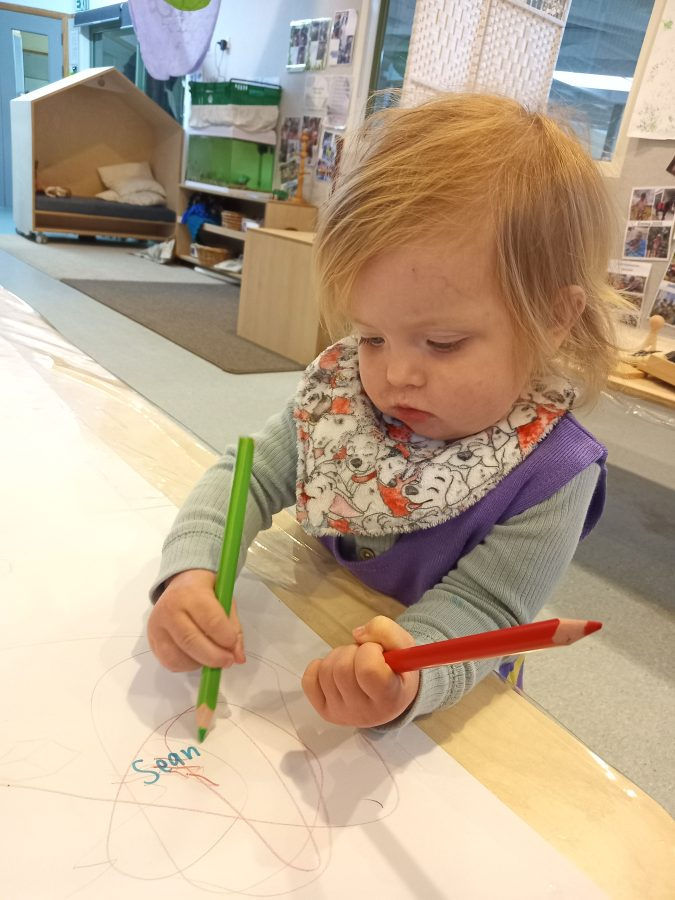
We also offer experiences that invite children to document their discoveries — drawing their insect findings, creating signs for block constructions, or co-authoring group stories inspired by local pūrākau. Through these experiences, they learn that they are authors, illustrators, and storytellers in their own right.
Teaching in action:
Shared storytelling and book-making.
Mat times rich in rhyme, rhythm, and contribution.
Visible print in meaningful contexts — names, routines, labels.
Local pūrākau that connect language, culture, and identity.

Our Shared Role – Home and Centre Together
Early literacy blossoms when tamariki are surrounded by words, stories, and people who delight in conversation. You can nurture this at home by:
Reading books daily — even the same favourite one.
Talking about what you see and do together.
Encouraging drawing, pretend writing, and storytelling.
Using your child’s name often — written, spoken, and celebrated.
Sharing family stories, songs, and pūrākau that connect to your heritage.

The article presents a comprehensive look into the nurturing environment for early literacy development at Te Ōki. It's intriguing how foundational experiences such as play and social interaction lay the groundwork for literacy, showing that Boo is not just about learning letters but embracing a broader cultural and emotional landscape. This reflective approach highlights the importance of integrating identity and connection in educational practices.
The approach to early literacy described in the article highlights the importance of rich interactions and meaningful experiences in fostering a love for learning. This foundation is crucial for children as they grow, yet I wonder how the emphasis on play translates into measurable outcomes. The mention of a jet casino of continuous engagement suggests a need for a balance between play-based learning and structured literacy milestones.